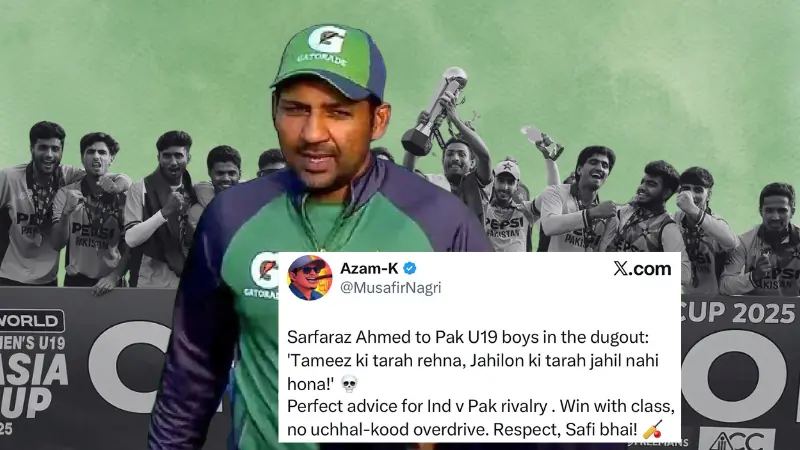
For Pakistan cricket fans, the U-19 Asia Cup final delivered everything they crave from an India showdown — dominance, redemption, and bragging rights. A record-breaking batting display, a ruthless bowling effort, and a humiliating 191-run defeat handed to a previously unbeaten Indian side. Yet, long after the scoreboard had settled, it was not the margin of victory that ignited debate across social media. It was a single sentence — sharp, timely, and unmistakably Sarfaraz Ahmed.
As Pakistan’s young guns closed in on victory at the ICC Academy Ground, tensions briefly flared. An Indian batter, dismissed amid mounting pressure, made a controversial shoe-pointing gesture. Adding to the unease, there was once again no post-match handshake — an absence that has become an uncomfortable norm in modern India-Pakistan encounters.
At that moment, with emotions running high and cameras rolling, Sarfaraz’s voice cut through the noise from the dugout:
“Tameez ke dairay mein rehna, jahilon ki tarah jahil nahi ho jana” — Remain civil. Don’t meet foolishness with more foolishness.
The line went viral instantly.
For many fans, it perfectly captured Sarfaraz Ahmed’s complicated legacy: fiercely competitive, unapologetically emotional, but deeply rooted in old-school cricketing values. This was not a man telling his players to tone down their joy — it was a reminder to let excellence, not arrogance, do the talking.
Ironically, the match itself had little need for added drama. Pakistan had already asserted supremacy in brutal fashion. Sameer Minhas produced a once-in-a-generation knock, hammering a monumental 172 — the highest individual score ever recorded in a U-19 Asia Cup final — as Pakistan piled up a daunting 347 for 8. India’s response never found momentum. Ali Raza ripped through the batting order, reducing a confident lineup to rubble as India folded for just 156 inside 27 overs.
It was emphatic. It was humiliating. And it was complete redemption after Pakistan’s earlier group-stage defeat to the same opponents.
Yet, the internet chose to obsess over Sarfaraz.
On X (formerly Twitter), “Sarfaraz, the mentor” trended relentlessly. Fans praised his intervention as the “perfect advice for the Ind-Pak rivalry,” applauding him for demanding restraint even in victory. One user mocked chest-thumping celebrations as “uchhal-kood overdrive,” arguing that Sarfaraz showed how to win with class rather than chaos.
Others turned the moment into instant meme culture. The phrase “tameez ke dairay mein” was repeated so often it began to resemble a national slogan. Viral posts likened Sarfaraz’s India-final aura to Kanye West’s infamous 2005 Grammys moment — inevitable, chaotic, unforgettable. An old clip of a fan hugging Sarfaraz while screaming “Sarfaraz bhai kabhi dhoka nahi deta” resurfaced, now rebranded as the only acceptable emotional response to his latest masterclass.
Zooming out, fans compiled Sarfaraz’s India-final résumé like a flex:
• 2006 U-19 World Cup final — beat India
• 2017 Champions Trophy final — demolished India
• 2024 U-19 Asia Cup final — mentored another win
For supporters, this wasn’t coincidence — it was destiny wrapped in discipline.
The Pakistan Cricket Board’s decision to appoint Sarfaraz as a mentor also earned overdue praise. Many argued that beyond tactics, his greatest contribution lies in teaching young players how to navigate politically charged rivalries without losing perspective. Passion without restraint, they noted, has cost Pakistan dearly in the past.
Sarfaraz himself doubled down post-match. In his press conference, he contrasted the sportsmanship of Indian teams he faced during his playing days with what he described as increasingly “inappropriate” behaviour now. His message was clear: rivalries may evolve, politics may intrude, but dignity should never be optional.
In an era where India-Pakistan cricket is often reduced to hostility, symbolism, and viral outrage, Sarfaraz Ahmed delivered a quiet rebellion. He didn’t silence celebration — he refined it. He reminded his players, and perhaps their rivals, that true dominance doesn’t need theatrics.
Pakistan didn’t just beat India that day. They outplayed them, outclassed them, and — thanks to one sharp line from the dugout — outgrew them.
And that, for many fans, was the most satisfying victory of all.